
AUSTRALIS · DEVLOG
Public reception, authorized operations
Historical period: 2026-07-01–2026-07-05
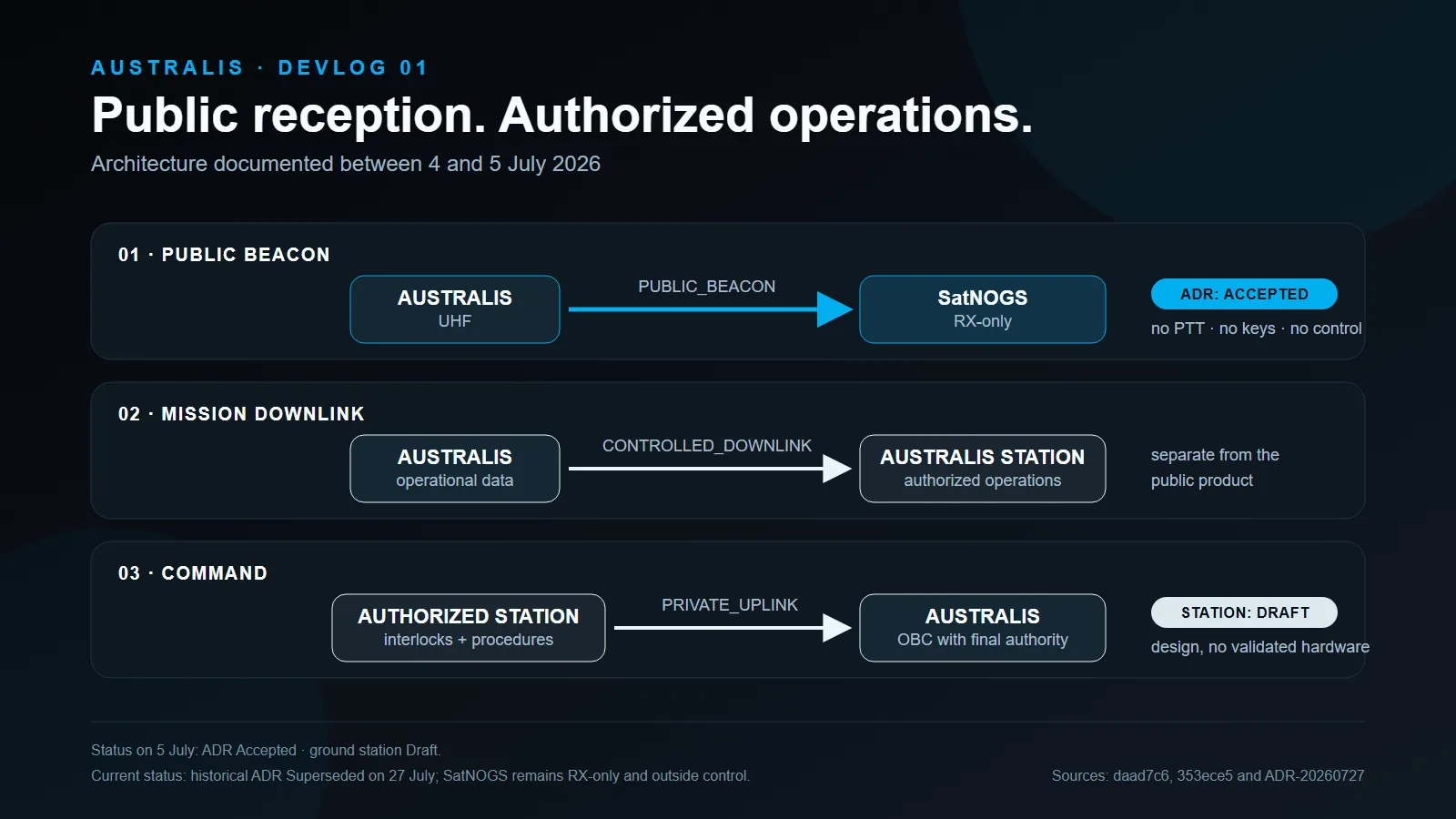
Between 4 and 5 July, AUSTRALIS turned an idea for community coverage into a traceable architecture for a documented public UHF beacon profile intended to be decodable by SatNOGS stations, separated from command and authorized operations.
The objective
An experimental mission can benefit from a global reception network: more stations can observe its signal, compare coverage and contribute independent evidence. At the same time, detailed operational telemetry and command require a clear separation of functions, permissions and procedures.
This week’s work sought to meet both objectives within the same UHF architecture, without adding a flight radio dedicated solely to SatNOGS.
What changed
On 4 July, an architecture decision with three link profiles was accepted:
- PUBLIC_BEACON: minimal, documented telemetry that third parties can decode.
- CONTROLLED_DOWNLINK: operational and payload data intended for the mission’s own or authorized stack.
- PRIVATE_UPLINK: commands and operations from mission-owned or authorized stations.
On 5 July, a dual-use ground-station design was added in Draft status. The proposal shares the UHF antenna and rotor while keeping public reception and AUSTRALIS operations on separate paths. SatNOGS participates as a reception network; the transmit chain remains behind T/R switching, interlocks and mission procedures.
Decision and work completed
The central decision was to treat the public beacon as a specific telemetry product, whose schema was required to be public and reproducible, without mixing it with detailed operational data.
The ground station was documented with:
- distinct operating modes;
- a logical receive/transmit diagram;
- a physical default return to receive;
- a safe sequence for enabling transmission;
- interlocks, a watchdog, and power and standing-wave ratio (SWR) measurement;
- implementation phases, risks and bill-of-material candidates.
Evidence and maturity
The public evidence for this week is documentary:
- an ADR in Accepted status;
- a documented beacon architecture;
- a ground-station design in Draft status;
- changes traced to requirements, risks, baseline, costs and repository architecture.
This represents an architecture decision and a documented preliminary design. The merge to main on 5 July made the documentation public, but did not by itself increase its technical maturity. Those commits did not add a prototype, a ground-station CAD model, a structural calculation or an end-to-end RF validation.
What we learned
Community openness and operational control can coexist when they are separated by design. The architecture allowed a single UHF system to provide a public beacon while keeping operational products in separate profiles and tools.
One important principle was also established: “controlled” describes access and the operational flow; it does not, by itself, guarantee confidentiality over an observable RF signal.
Later evolution
The ADR was in Accepted status at the end of this historical week and moved to Superseded on 27 July, when it was replaced by a new RF and regulatory baseline. That revision avoided fixing 435 MHz as the exact frequency, kept modulation, bitrate, power and hardware as candidates, and strengthened authentication, integrity and anti-replay requirements for command.
The core principle remained: SatNOGS is RX-only, with no access to PTT, keys or control; mission operations use authorized paths.
Milestone planned at the time
The COMMS milestone planned at the time for Gate C was to turn the architecture into bench evidence: generate the beacon with candidate hardware, receive it locally, decode it reproducibly and verify that it contained only the intended public fields. Regulatory coordination, hardware selection and mechanical design remained later work.